

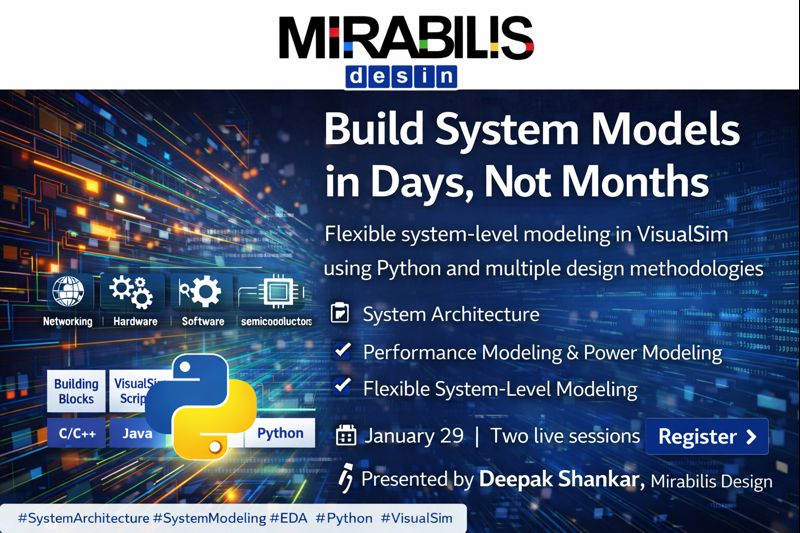
Flexible system-level modeling in VisualSim using Python and multiple design methodologies
Register Now: January 29 | Two Live Sessions
Asia Session
🕚 11:30 AM IST | 🕑 2:00 PM CST | 🕒 3:00 PM JST/KST
👉 Register:
Webinar: 🚀 Start Modeling with Python.Asia
US / EMEA Session
🕙 10:00 AM PST | 🕐 1:00 PM EST
👉 Register:
Webinar: 🚀 Start Modeling with Python. USA/EMEA
System-level modeling is no longer optional.
As systems grow more complex—spanning software, hardware, networking, RF, power, thermal, and mechanical domains—architects need early visibility into performance, power, and system behavior. Yet many teams struggle to adopt system-level modeling due to long ramp times, rigid methodologies, or tools that don’t fit how engineers actually think and work.
In this webinar, Mirabilis Design shows how VisualSim enables system modeling that adapts to your style—not the other way around.
VisualSim has always supported multiple modeling methodologies, including graphical building blocks, VisualSim Script, C/C++, and Java. Now, Python becomes a powerful new enabler, allowing architects to build custom models and logic using a language they already know—while remaining fully integrated with the proven VisualSim simulation infrastructure.
Why This Matters
- Faster model development means more architectural exploration
- Earlier insight into performance, power, and behavior
- Lower adoption barrier across teams with diverse backgrounds
- One platform for end-to-end system modeling
What You’ll Learn
- How VisualSim supports multiple modeling methodologies to match different architect workflows
(networking, software, hardware, semiconductor, and system architects) - How Python can be used to build custom blocks and logic while leveraging:
- Familiar syntax and tooling
- Large libraries of statistical and mathematical functions
- Templates that accelerate ramp-up
- How Python models plug directly into the VisualSim ecosystem, including:
- Discrete-event simulation
- Power tables and power analysis
- Failure and fault analysis
- Requirements management, tracking, and traceability
- Traffic and workload modeling
- Hardware, software, network, mechanical, and RF system models
- Why system-level modeling is critical for making confident design decisions before RTL, prototypes, or hardware exist
Who Should Attend
- System and SoC architects
- Performance and power modelers
- Software designers and system engineers
- Networking, semiconductor, automotive, aerospace, defense, and communications teams
- Engineers looking to adopt system-level modeling without long training cycles
🔹 Webinar Details
📅 January 29 | Two Live Sessions
Asia Session
🕚 11:30 AM IST | 🕑 2:00 PM CST | 🕒 3:00 PM JST/KST
👉 Register:
Webinar: 🚀 Start Modeling with Python.Asia
US / EMEA Session
🕙 10:00 AM PST | 🕐 1:00 PM EST
👉 Register:
Webinar: 🚀 Start Modeling with Python. USA/EMEA
🎤 Presented by:
Deepak Shankar
Founder & Chief Technologist, Mirabilis Design


