

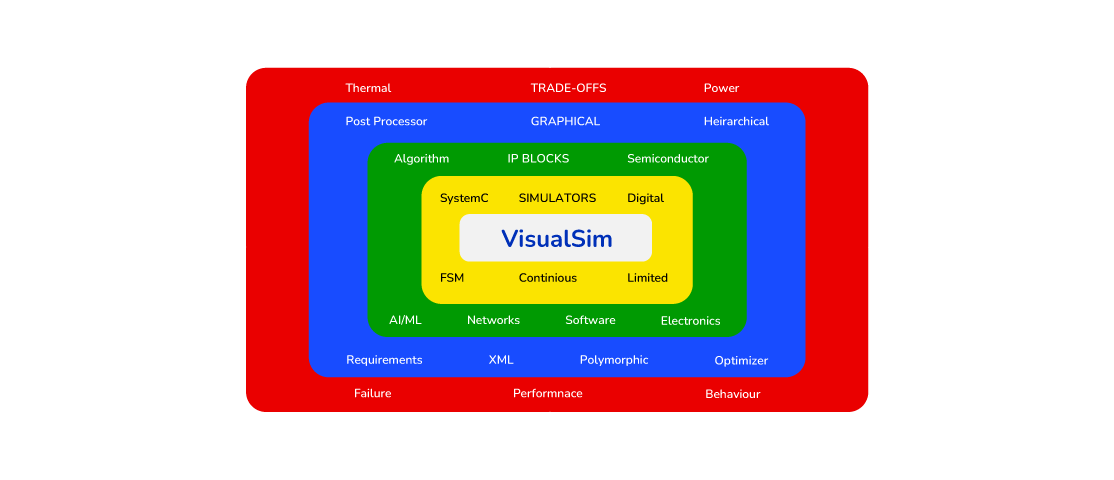
Pre-development design and simulation of SoC, chiplet, software and system architectures
Evaluate algorithms, signals, latency, throughput, failure and power across real workloads
Vendor, standards, builders and application models. Integration of simulators, languages and requirements

Semiconductors

Electronics

Software

Networking

RF
In today’s technological race, design cycles are shrinking while complexity is skyrocketing. VisualSim Architect helps:
Engineers and Architects validate specifications early, explore design alternatives, and detect hidden bottlenecks.
Product Managers and Executives evaluate power, performance, and cost trade-offs to guide product strategy.
Verification Teams integrate C, C++, Java, Python, SystemC, RTL and hardware-in-the-loop (HiL) simulations to ensure the final design meets requirements.
Drag-and-drop block diagram modeling with support for hierarchy, reusable sub-systems, and version-controlled libraries.
Explore architectures that span hardware, software, analog, digital, and networks—all in one environment.
69+ standards and 85+ application templates, plus 500 technology IP blocks, accelerate model creation and experimentation.
Based on an Open DTD XML, with APIs and interfaces to third-party tools, simulators, and languages like C, C++, Java, JSON, VCD, traces, STK, SystemC, and MATLAB/Simulink.
Built-in error detection, syntax checking, tracing, and logging ensure model accuracy. Graphical debuggers and report generators provide clear insights.
Quickly generate runs with different combinations of parameter values, traces, input files and configurations to performance, power, latency, throughput, and functional correctness across design options. Run “what-if” studies to optimize architectures for your unique goals.
Teams across semiconductor leaders, automotive innovators, aerospace agencies, and data center architects can share models and develop the final product. Over 250 products worldwide have been architected using VisualSim.
Integrates requirements with the simulator to track the model operation in real-time to capture bottlenecks and assess the reason for the model to not meet the requirements.
VisualSim Architect is designed for a distributed, multi-user development environment. Each system element—such as a processor, NoC switch, or ECU—is defined as an independent XML component file containing modeling blocks, custom code, or scripts. A top-level system model integrates these components by reference, not by import, ensuring that updates to any component are automatically reflected across all linked models. Parameter values set in the system model remain intact even as underlying XML files evolve. This architecture enables teams across global locations to collaboratively build, refine…
How does throughput scale when moving from a single-die AXI SoC to a multi-die UCIe-based SoC?
What is the latency and QoS impact of distributing autonomous driving workloads across multiple ECUs?
How much energy consumption varies across satellite orbits in a multi-role mission?
Which interconnect—PCIe or Ethernet—is more suitable for safety-critical avionics systems?
With VisualSim, these questions can be answered in hours, not months, with quantifiable data instead of assumptions.
VisualSim Architect supports multiple industry-standard methodologies, including:

Y-Chart exploration (function ↔ architecture ↔ mapping)

Use-case to architecture mapping

Network flow modeling

Hardware/software partitioning
Catch problems early, shorten design cycles, and reduce re-spins.
Evaluate trade-offs virtually before committing resources.
Engineers and management share a common modeling and reporting environment.
Explore new standards, topologies, and technologies with confidence.


